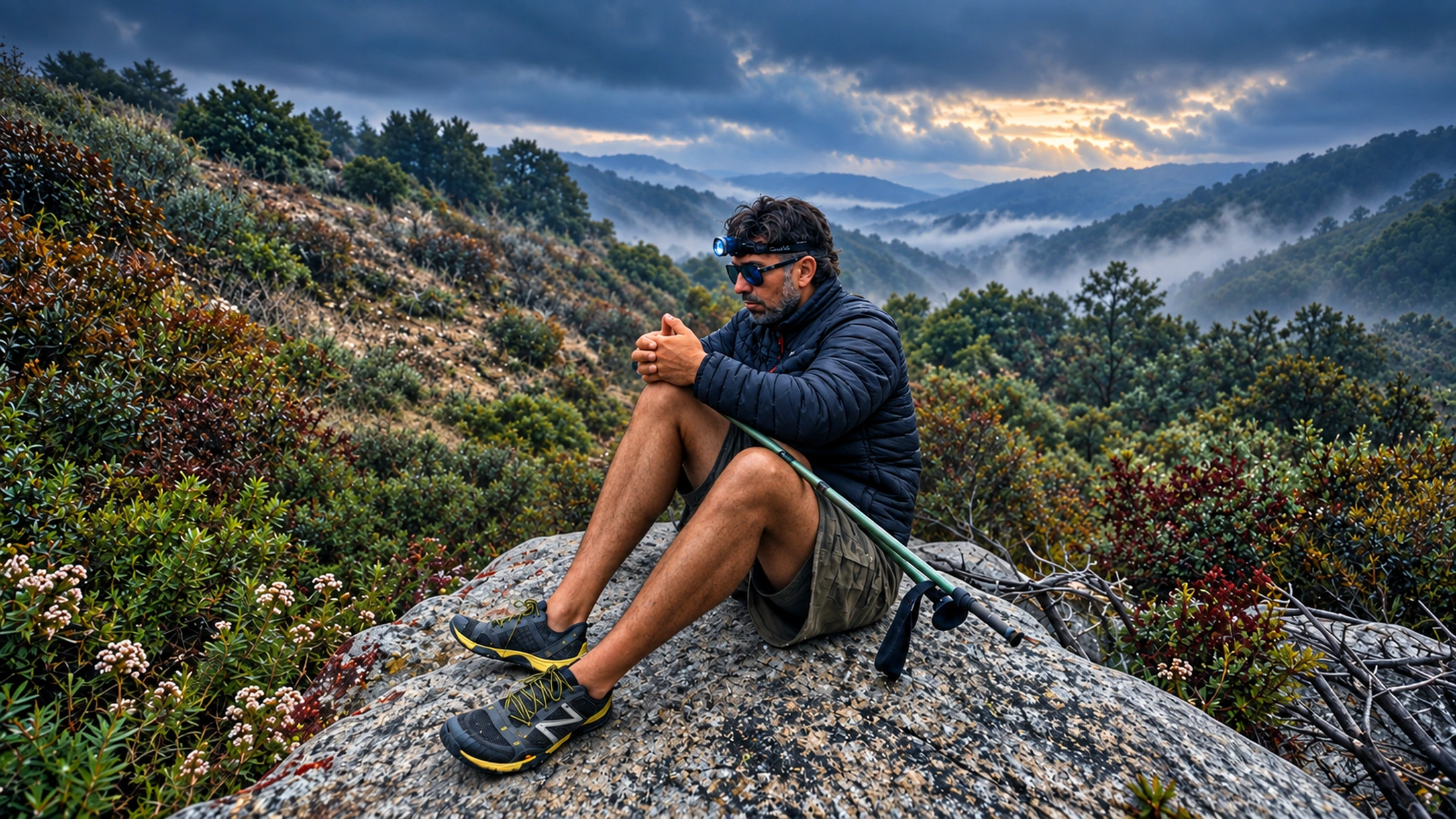
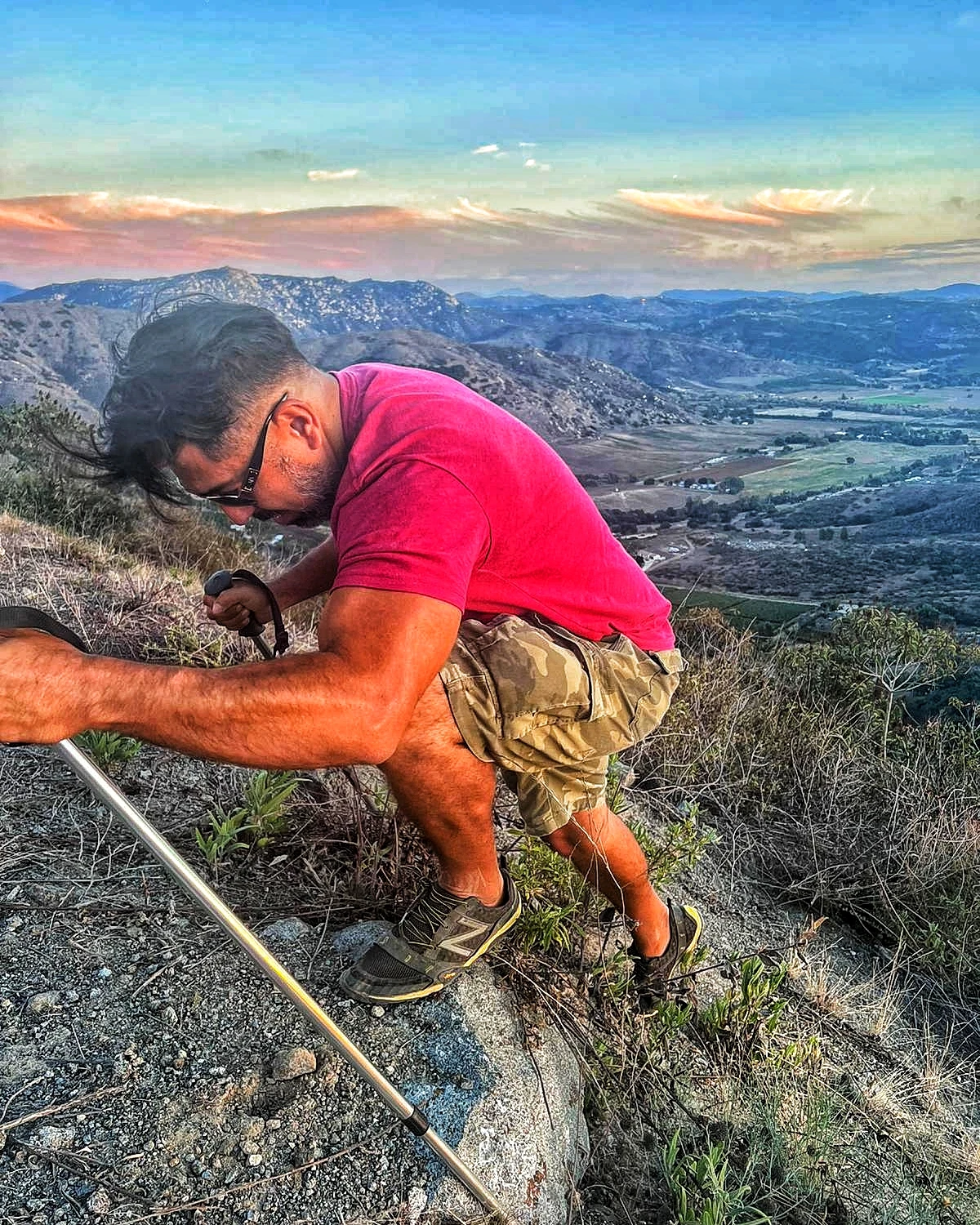
PERIOD: EVEREST-PREPARATION ERA · EXACT DATE / YEAR TBD
OPENING
There are moments when years of preparation collapse into a few seconds. I had spent years building toward Everest. Walking farther. Carrying weight. Climbing. Camping.
Returning to the mountains almost every day. Trying to make my body stronger and my judgment cleaner. Trying to become the kind of person who could stand inside a serious objective without confusing ambition with readiness. Then, on one climb, the direction of the entire story changed. I slipped on ice. I fell roughly 40 to 50 feet down a ridge .
And the future I had been training toward stopped looking the same.
The fall lasted seconds. The consequences lasted years.
THE MOUNTAIN STAYS UNNAMED
The mountain has a name. I am choosing not to use it here. That is deliberate. I do not want a beautiful mountain reduced to the worst thing that happened to me on it. The mountain did not betray me. The mountain did not make a promise and break it.
It was simply there—high, beautiful, demanding—and under snow, ice, and harsh conditions, the terrain became unforgiving. That distinction matters to me. I can tell the truth about what happened without turning the place itself into a villain. So publicly, this chapter will leave the mountain unnamed. Not because I am ashamed of what happened. Because I still respect where it happened.
The story belongs here. The mountain does not need to be identified for the story to be true.
BEFORE THE FALL
By then, the mountain life was not casual. The preparation had become serious. I remember the Everest-training period as nearly five years in total, though the exact start and end dates still need to be verified. I had been hiking long distances. Training with a loaded pack. Camping for extended periods in the mountains.
Climbing. Rock climbing. Spending enough time outside that the mountains no longer felt like an occasional destination. They had become part of the structure of my life. The goal was not to prove I was fearless. Fearlessness is not the same thing as judgment.
The goal was to prepare. To become stronger. To become more capable. To learn how my body behaved under fatigue. To learn what changed when the terrain changed. To learn when persistence was useful and when persistence could become stupidity.
I was training for a mountain much larger than any single day of preparation. That made every ordinary climb part of a larger conversation.
WHEN CONDITIONS CHANGE THE MOUNTAIN
A mountain can be beautiful in one set of conditions and completely different in another. Snow changes footing. Ice changes consequence. Cold changes the body. Visibility can change judgment. The same slope does not remain the same problem after weather has transformed it.
That is one of the lessons serious mountains teach without caring whether you are ready to hear it. On the day of my fall, snow and ice had made the terrain treacherous. I do not need to exaggerate it beyond that. I do not need to call the mountain evil. I do not need to turn the story into a survival movie. The conditions were enough.
Real terrain does not need dramatic language to become dangerous.
THE FALL
I slipped on ice. Then gravity took over. I remember the distance as roughly 40 to 50 feet down a ridge . That number is an estimate from my own recollection, not a surveyed measurement. I am keeping the approximation because precision would imply records I do not have. What I do know is that it was far enough to change my life.
The story does not become more honest if I add details I cannot verify. I do not remember every movement of the fall with documentary precision. I am not going to reconstruct a second-by-second sequence from imagination. I am not going to invent the exact angle, the exact speed, or an exact landing position because those numbers would make the writing sound cinematic while making the record less truthful. What matters is what I know.
I fell. I was hurt. And the plan I had spent years building toward was no longer the plan I could keep following.
WHEN THE BODY ANSWERS
My back was injured. Both shoulders were injured. My knees were injured. Those injuries did not exist as abstract words. They entered ordinary life. Movement changed.
Training changed. Recovery became something I had to think about instead of something I assumed would happen quickly. The body that had been the vehicle for the Everest dream suddenly became the thing that required attention before any dream could continue. That reversal was difficult to accept. For years, I had trained my body to do more. After the fall, I had to learn how to live with what it could not do in the same way anymore.
That required a different kind of discipline.
EVEREST MOVED OUT OF REACH
Before the fall, Everest was a direction. A long-term objective. Something the training pointed toward. After the fall, the objective had to move aside. Not because the dream suddenly meant nothing. Because the body had made the immediate priority very clear.
Heal. Recover. Relearn. Adapt. The years of preparation had taught me to keep moving toward a goal. The fall taught me that sometimes the responsible move is to stop moving toward the goal you wanted and deal honestly with the reality in front of you.
That was harder for me than another long day on a trail. Ambition likes forward motion. Recovery does not always look like forward motion. Sometimes recovery looks like repetition at a scale so small that the person you used to be would not have called it progress. But it is.
THE EMOTIONAL FALL
The physical injuries were only one part of what happened. The fall was also an emotional setback. I had invested years into the idea of becoming ready for Everest. That objective had given structure to thousands of decisions. Where I went. How I trained.
How much I carried. How far I walked. How I thought about discomfort. What I believed I was becoming. When the fall interrupted that path, it was not simply a cancelled trip. It felt like losing access to a future I had spent years constructing.
I have described that period as bringing a measure of depression with it. I use that wording carefully. I am describing my experience, not trying to turn a chapter into a diagnosis. But the emotional weight was real. The body hurt. The objective moved away.
And for a while, the distance between the life I had imagined and the life I could actually live became difficult to look at.
I had trained for years to climb higher. Suddenly the work was learning how to stand inside a life that had changed.
THE SPIRITUAL FALL
There was a spiritual dimension too. I believe things happen for a reason, but belief does not mean every reason arrives immediately labeled and understandable. Sometimes faith is easy to talk about when the plan is working. It is different when the plan disappears. I had to sit with questions I did not enjoy. What if preparation does not guarantee arrival?
What if discipline still ends in interruption? What if the dream is real but the timing is no longer mine? What if the lesson is not about reaching the summit at all? I did not receive one dramatic answer. What I received was time. Pain.
Recovery. And the slow realization that a life cannot be measured only by the objective that was interrupted.
The mountain years had trained me to endure effort. Recovery would test whether I could endure a different kind of effort—one with less spectacle, less certainty, and no summit photo at the end.
THE MOUNTAIN WAS NOT THE ENEMY
This matters enough to say again. I do not blame the mountain. I do not want somebody to read this chapter and come away believing that the place itself deserves fear, blame, or a damaged reputation because I fell there. It is a beautiful mountain. Under winter conditions, parts of the terrain became treacherous. Those are not contradictory truths.
Beauty does not guarantee safety. Risk does not erase beauty. Respect requires holding both at once. That is why the public story stops short of naming the location. The accident belongs to my biography. The mountain does not need to become branded by it.
WHAT I WILL NOT INVENT
There are gaps in this chapter. I am leaving them visible. The exact calendar date is TBD . The exact year is TBD . The roughly 40–50-foot distance is my recollection, not a formal measurement. The injuries listed here are the injuries I have consistently described: my back, both shoulders, and my knees.
I am not publishing a reconstructed medical chronology without records to support it. I am not publishing a fabricated rescue sequence. I am not assigning thoughts to other people who may have been around me. I am not adding dialogue because dialogue makes a story read better. I am not naming the mountain. Documentary integrity sometimes means allowing a sentence to remain incomplete until evidence catches up with memory.
I would rather leave a blank honestly than fill it beautifully with something that did not happen.
THE LONG WAY BACK BEGINS
The fall did not end when I stopped falling. That is one of the strange things about an accident. There is the event. Then there is the life after the event. For me, that meant years of rehabilitation and recovery. It meant slowly trying to heal a back, shoulders, and knees that had absorbed the consequences of one bad moment on ice.
It meant trying to return to movement without pretending I was already the person I had been before. It meant measuring progress differently. It meant carrying the memory of what happened back into the same world I still loved. The mountains did not disappear from my life. But my relationship with them changed. I had more respect for how quickly conditions can alter consequence.
I had more respect for the body. I had more respect for the distance between confidence and control. And I had to learn that returning is not the same thing as going backward.
LOOKING BACK
For a long time, I could have defined the fall by what it took from me. The Everest plan. Physical capacity. Time. Momentum. Confidence in my body.
Years of recovery. All of those losses were real. But they are not the only meaning I carry now. The fall also exposed a truth that ambition can hide: I was never in complete control. No amount of training changes that.
Preparation matters. Skill matters. Judgment matters. Discipline matters. And still, real life keeps the final vote. That is not a reason to stop climbing.
It is a reason to climb with humility. The version of me who trained for Everest wanted to become capable enough to stand on the highest mountain in the world. The version of me who survived the fall had to learn something harder: How to live when the mountain changes the plan.
ARCHIVE
[TBD — exact date / year of the accident once verified] [TBD — contemporaneous photographs, only if they can be verified and do not reveal the protected mountain] [TBD — training records from the period] [TBD — medical documentation, private by default unless deliberately approved for publication] [TBD — rehabilitation records, private by default] [TBD — journal entries or messages written close to the event]
[TBD — later reflections clearly labeled as retrospective] No photograph should be presented as documentation of the accident unless it genuinely comes from the event and is intentionally approved for public release. No public asset should reveal the mountain through metadata, captions, filenames, geotags, maps, or embedded location information.
THE LINE I CARRIED FORWARD
The fall changed the mountain I was climbing. It did not end the climb.